
Voyages et aventures du capitaine Hatteras (The Voyage and Adventure of Captain Hatteras) by Jules Verne.
- Lukaschik Gleb
- Jan 2
- 4 min read

Updated: Jan 3
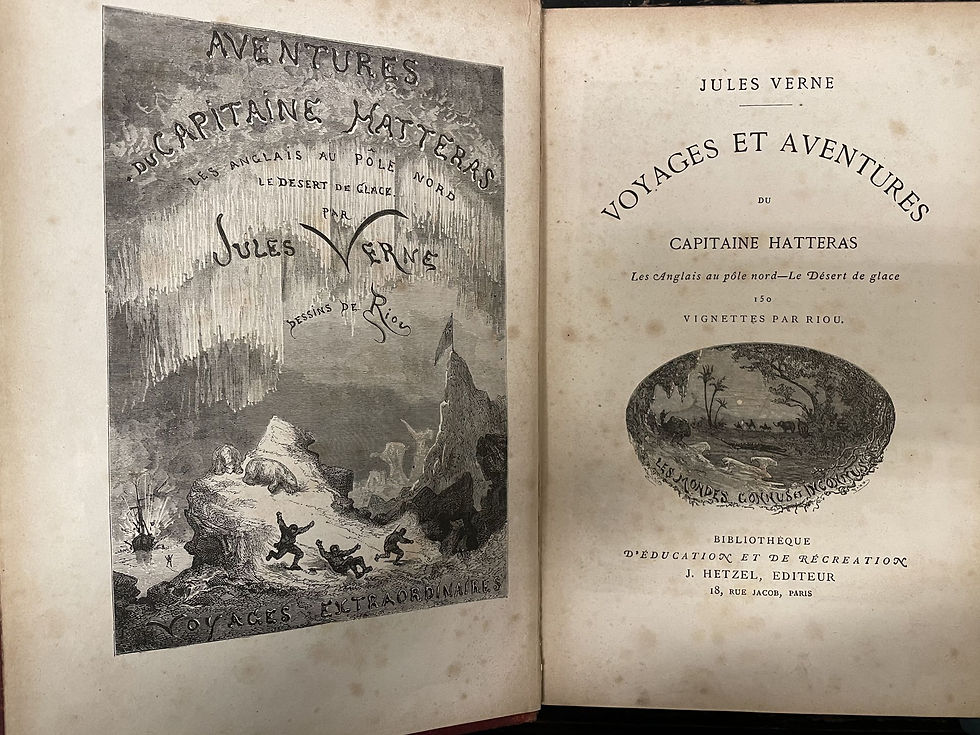
Jules Verne offered the manuscript Paris in the Twentieth Century to Hetzel in 1863. The publisher rejected it, because considered writer’s vision of the future as too far from be believable and a quite dark vision of it would hurt sales, which in his view would be worse than Five Weeks in a Balloon. Verne never came to arguing with Hetzel and always accepted his said at the first several years. He returned to adventures, which the next one began to write for a new children literature Magasin d’education et de recreation (Magazine of Education and Recreation), which appeared in January 1864 and originated from his collaboration with the publisher. This was mostly the first place where the French author’s books appeared by being serialized in chapters. It was later Pierre-Jules Hetzel released the written as single book editions: an ordinary without illustrations and having a lavishly decorated cover. Verne lettered for this magazine The English at the North Pole from March 1864 to February 1865 and The Desert of Ice from March to December of 1865, which both were parts of one composition. It was The Voyage and Adventure of Captain Hatteras. Appearance in completed edition was in November 1866, and it became a first had a title “Extraordinary Voyages”. Five Weeks in a Balloon was added to the series in hindsight.
Since his first written book, Jules Verne followed his self-made formula many times: it’s about a group of adventures who set a goal to reach uncharted via non-standard constructed machine, which in The Voyage and Adventure of Captain Hatteras is a hybrid of steam and sail ship.
As well, there are other defining things, but they are not splendid. The first chapter repeats in informing about the ship’s horsepower and weight, assumes and reveals three times where it heads, and there asks needless questions for which find obvious answers. Containing explosives on this ship is enough to blow up the Liverpool Customs in depicting can characterize as “Jules Verne’s metaphor”. Sometimes the describing have a conversational thing. All that will further.
Nevertheless, the plot was intriguing in its mystery of a man who organized expedition and the movement into unknown. Reading became unlikeable because Verne overloads it with facts about geography, adventurers and discoveries. As it finds out, putting of such information was a goal of Hetzel, by turning Verne’s books into educational ones too. At first, the writer embeds information accurately through believable talks between characters. I could accept that sometimes that a personage gives knowledge for want to show he knows this fact. But you will begin to see it as intrusive soon. Conversations become recitations of facts. It will take several dozen pages for that the writer becomes sloppy by just blindly inserting information. It’s simply facts without details: names and the years of their achievements. The author is perceives here as an obsessive man in his inclusion of knowledge, as when he writes that the ship was close to running aground and mentions a real vessel that did so. The Frenchman does that against the plot, as when the ship sails to an island because it against the received instruction from the mysterious man who organized that expedition. It does for throwing out of place’s facts, such as how much costs any sea inhabitant.
The author occupied the book with many needless sentences, which restate already known, details and feelings that should be understandable with pointed characters, a personage expresses his guess where to move though a received letter just explained it. Sometimes thoughts of characters accept as filling of their void as it does by sport commentators, and that feeling was with reading of Five Weeks in a Balloon.
Verne can fail so close. He depicts that in front of the ship is occupied by ices. The next paragraph warns about the danger of coming ices. Or he makes a meticulous of mentioning of latitudes and geographic details, but commits a big hole misfire, claiming that the ship moves near of Newfoundland and it follows in taking a north-east wind and finds out at the coasts of Norway, which is closer to Greenland, and uses the Davis Strait. All that occurs in several days.
A story could be mighty, but it didn’t stand by that Jules Verne wasn’t a masterful teller. I dropped it on the tenth chapter in this time. I began to list pages to find out that the crew still suffers from snow’s whiteness. The Frenchman couldn’t be convincing in dangers, which had to be contrived as it becomes familiar since the first book. The heroes escape from a snow house whose top bent down for long time, but they leave it effectively before it ruins.
The intrigue with the captain is blank. This person was on the vessel all the time, but his dog, which was also there, admitted him after he disclosed his identity. The ship’s quartermaster claimed that knows all sailors, but reveals it is not so if one of them is the captain and organizer of the expedition. And a name of their leader is widely known as it reveals; therefore if he and his obsession with the Pole were supposed to emerge in assumptions. Certainly, the ruining of the novel included the intrusion of the publisher, who didn’t want that the mad captain Hatteras ended by jumping into a lava crater. That made Verne to far-fetch, giving him blindness after a splash of lava.
I wrote in a review of Five Weeks in a Balloon that I believe the author disliked Americans. That attitude captain Hatteras has, whereas the initial edition contained more disdain for this country as that expresses the quartermaster in saying and making a respective feeling (“Oh, those Yankees!” replied Johnson, with a gesture of annoyance), which both do indirect pointing on the truth that couldn’t be covered by that characters are Englishmen for whom such attitude can’t be unusual.
It was probable that I could read The Voyage and Adventure of Captain Hatteras entirely, but the informativeness in facts was taking away the naturalness from characters and happenings, because after surviving an extreme situation, the quartermaster wants to know scientific details. Jules Verne is not delicate as writing fiction. His unpublished under Hetzel Backward Trip to England and Scotland was usage of own travel, in which he changed names to turn into fiction, but that happening story, as I found in research, is uninformative events.


